
The Value You Don’t See
The most expensive mistake when buying an antique isn’t necessarily paying too much. It’s buying the wrong thing.
(Scroll down to watch the video.)
We accept the value of expertise readily elsewhere. You wouldn’t expect to recognise the structural merits of a building simply because you admire its façade, and you wouldn’t assume you could perform surgery simply because you’ve cut an apple. Yet when it comes to antiques, it can be tempting to believe that what we see tells us everything we need to know and therefore we’re an expert.
A photograph can tell you whether you like a piece of furniture. It cannot necessarily tell you whether the proportions have been altered, whether the hardware belongs, whether an old repair matters, what quality grade it is, and so on.
This is the less visible side of buying antiques — and arguably where an experienced dealer earns their keep.
Experience changes the way a piece is looked at. A dealer is not simply asking whether something is beautiful. They are considering its construction, timber, surface, age, alterations and condition; whether the quality warrants the description; what might be hiding beneath an old repair; and, ultimately, whether the piece is worth buying at all.
That last question matters.
A dealer will view thousands of pieces of furniture across the course of a year, and there is far more furniture that we don’t buy than furniture we do. Knowing what to walk away from is as important as recognising the exceptional piece amongst it.
For the eventual owner, the benefit is deceptively simple: much of the questioning, problem-solving and uncertainty and hard work has already taken place before you ever encounter the piece. By the time the antique reaches a showroom, a considerable number of decisions have therefore already been made on the buyer’s behalf.
There is sourcing and the intellectual exercise of vetting, certainly, but also the practical business of moving furniture across the globe: regulation, permits, freight, importation, transit, fumigation, photography, storage — the list goes on. Then comes another assessment when it arrives and one of the most nuanced decisions of all: what, if anything, should be restored?
Should antique furniture be restored?
Restoration requires an understanding of what gives a piece its integrity and the confidence to know when to intervene — and when to leave it alone. A previous restoration may be best left untouched; a missing piece of marquetry might warrant replacement or careful hand-brushing. The answer is rarely the same from one piece to the next. Knowing the difference is where experience matters.
Watch our latest restoration from the collection here.
Enquire about this English side table.
And when intervention is necessary, how it is undertaken matters too. Traditional cabinetmaking, polishing, gilding and upholstery are highly skilled disciplines. In 18th and 19th century France, highly regulated guild systems helped protect specialist crafts and maintain exacting standards of workmanship. The right craftsman, materials and techniques can preserve the qualities that made an antique worth acquiring in the first place. The wrong ones can diminish them.
This recent Wallrocks restoration is one example. The visible transformation is satisfying, but it is not really the point. The value lies in the decisions behind it: what to retain, what to repair and which traditional techniques to employ.
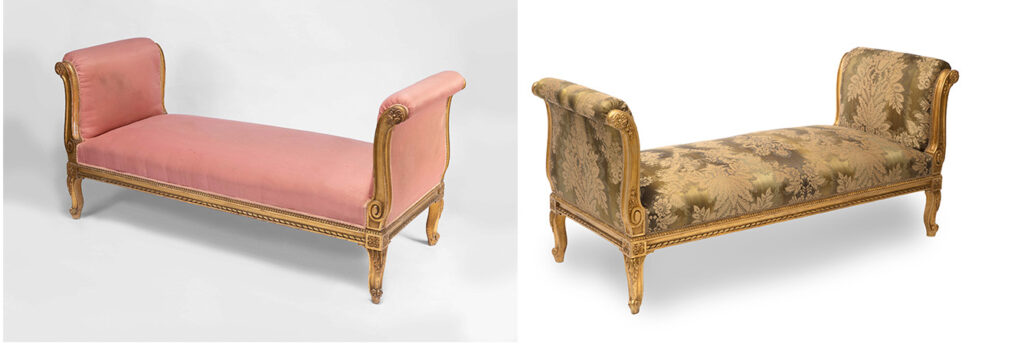
(Before & after restoration of 19th century French gilded window seat.)
Importantly, this is not simply a checklist of services. It is the accumulated judgement behind them.
Problems with antique furniture are rarely uniform, and neither are the solutions. What is entirely acceptable in one piece may be concerning in another; what warrants intervention in one may be precisely what should be preserved in the next. There is no manual that substitutes for having seen these things repeatedly, in different forms and at different levels of quality.
It is easy to think of an antique dealer as the person standing between an object and its eventual owner. A good dealer should be doing considerably more than that.
So, why buy from an antique dealer?
A good antique dealer does more than find a piece worth owning. They do the work that makes it easy to own.
They have found it, questioned it, assessed it, transported it and sought out the craftspeople capable of preserving it properly. Behind those decisions sits something that cannot be acquired quickly: years of handling furniture, seeing mistakes, recognising quality and developing relationships with skilled craftspeople.
Much of this disappears by the time the finished piece reaches the showroom.
Which perhaps explains something about the price of a truly beautiful restored antique.
You are not only buying the object in front of you. You are also buying the judgement that put it there.
Read our guide to How to Buy Antiques or View the Restoration Gallery