
A Formal French Salon Table Intended for a Formal Interior
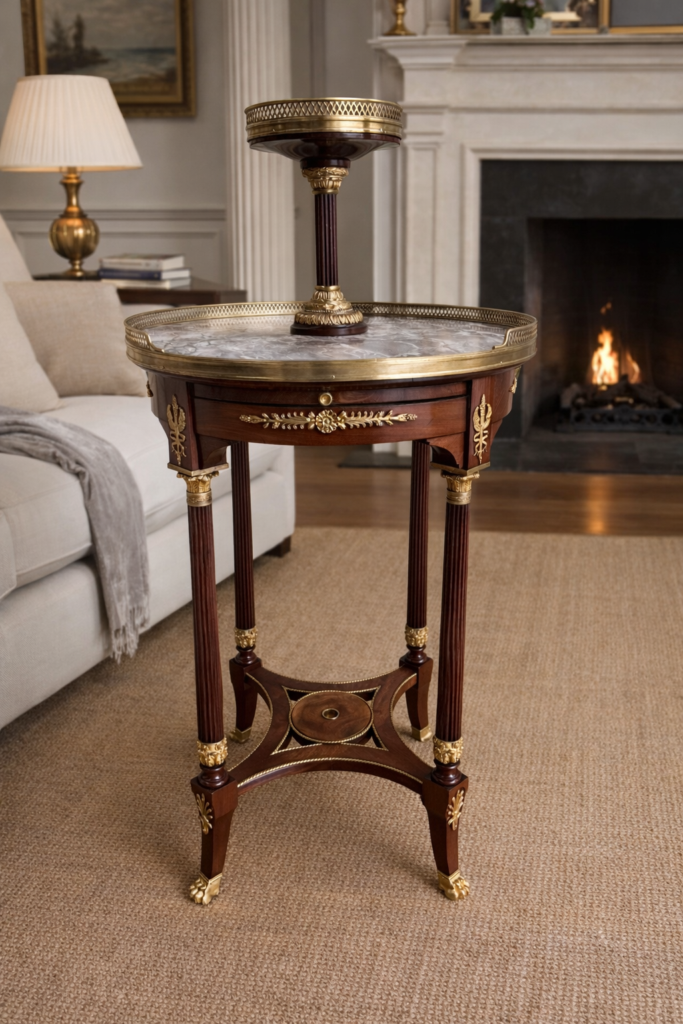 It is important to understand that a table such as this is not merely functional furniture, but an object of art and a sculpture – an object that elevates an entire room.
(Scroll Down to Watch the Video)
This formal French salon table, influenced by both Louis XVI and Empire styles and made during the 19th century, distinguished itself to us immediately. Its architectural balance, restraint, and quiet confidence set it apart from the vast majority of pieces encountered when sourcing.
A neoclassical French occasional table of this calibre is increasingly difficult to find — particularly one suited to considered, classically composed interiors where proportion and material truly matter.
The day we found this piece had been a challenging one. Poor conditions, little of interest, and we had decided to call it a day. Then, in the corner of the room, half-forgotten and covered in dust, sat this unassuming table.
To most, it was simply another antique side table. To us — and particularly to our founder, Nick Wallrock — it was precisely the reason we continue to travel and search around the world.
A Closer Look at the Craftsmanship and Design Details
The design reflects the Louis XVI and Empire characteristics — styles defined by their clarity of line, symmetry, and classical restraint.
What separates a truly exceptional Louis XVI side table from the ordinary is the union of three elements:
-
Architectural proportion
-
Material quality
-
Precision of execution
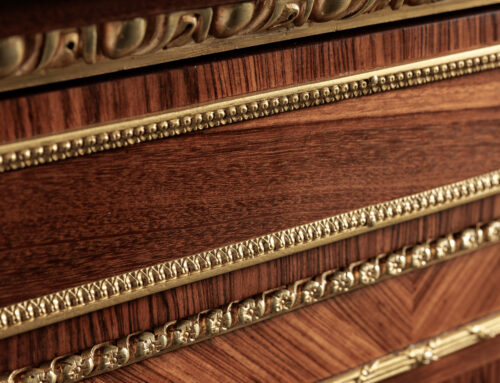
This table achieves all three in a rare harmony. The twin brass galleries, finely cast and crisply detailed, frame Breccia marble of exceptional tone and movement. These are supported not by veneer, but by solid flame mahogany — richly figured and deeply toned — with elegant reeded legs that reinforce the table’s vertical rhythm.
The gilded bronze mounts are particularly noteworthy: finely cast, sharply chased, and restrained in their placement. They enhance, rather than overwhelm, the form. A concealed leather-lined slide beneath the top provides a subtle, practical function — intended originally for a candle or glass — without interrupting the purity of the design.
Enquire About This Salon Table
What Makes this Salon Table so Exceptional?
Why This Piece Stood Out to Us
This formal French salon table possesses a feature we find particularly remarkable.
The smaller marble platform can be removed from the lower stretcher and repositioned at the centre of the main top via a turned mahogany dowel. In doing so, the table transforms — functioning as a raised display or “dumb waiter” for objects, flowers, or sculpture. When not in use, the aperture in the base is finished with an elegant gilded brass finial — a detail that speaks volumes about the level of thought invested in the piece by the cabinetmaker.
Equally telling is what cannot be seen.
The underside of the removable shelf is finished in polished flame mahogany — a material typically reserved only for visible surfaces. This level of unseen quality is a clear indication of a cabinetmaker working not to a price, but to a standard. The table was made by a meticulous cabinetmaker for an exacting client. It is a testament to the sort of man that made this table, that a surface that no viewer will ever see, is made from one of the finest materials available.
Why Pieces Like This Table are so Hard to Find?
Tables of this quality were never produced in large numbers. They required exceptional materials, highly skilled labour, and clients willing to commission work without compromise. Even at the time of manufacture, this would have been an expensive and considered piece.
Over the past century, such tables have dispersed globally, and many have been lost, altered, or diminished. While later reproductions attempted to capture this style, they rarely achieved the same balance, proportion, or material integrity. To a trained eye, the difference is immediate and the quality devastating by comparison.
A true neoclassical French occasional table of this standard is now genuinely scarce.
How to Style a Formal French Salon in a Considered Interior?
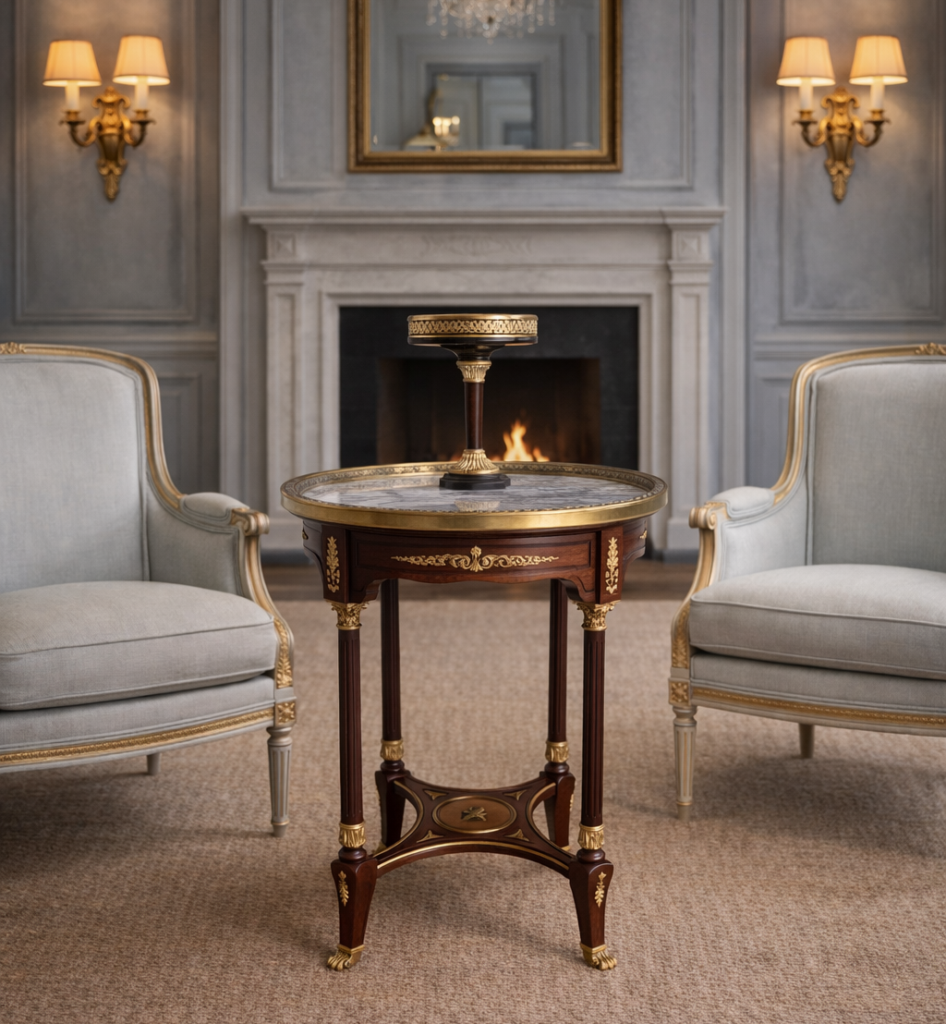
Despite its 19th-century origin, this table integrates seamlessly into both traditional and contemporary classic interiors. Its strength lies in its architectural clarity.
In a modern classic setting, it works best when given space — surrounded by restrained palettes such as ivory, stone, and soft greys, allowing the richness of the mahogany and marble to stand forward.
In a more formal interior, it sits beautifully between a pair of Louis XVI armchairs, where symmetry and proportion can be fully appreciated and colour pallet can be more bold.
The key is restraint — this is a piece that leads. It does not follow.
Who is This Table Perfect For?
This table is suited to a buyer who understands that exceptional interiors are built, not assembled. Someone who recognises that true quality — in material, proportion, and craftsmanship — cannot be substituted.
And that a single, remarkable piece will always outperform a room full of the ordinary and mediocre.
What to Look for When Buying a High Quality Salon Table?
When considering a formal French salon table, several factors are critical:
-
True material quality
-
Precision of mounts and casting
-
Balance and proportion
-
Integrity of original design and function
Without these, one is not buying quality — only the appearance of it. Identifying that distinction is rarely straightforward without experience.
Watch a Detailed Walkthrough of the Salon Table
The accompanying video explores this Louis XVI salon table in detail — from its construction and materials to the subtleties that distinguish it from lesser examples.