
Words, words, words. Easily dreamed, effortlessly spoken, oft exaggerated.
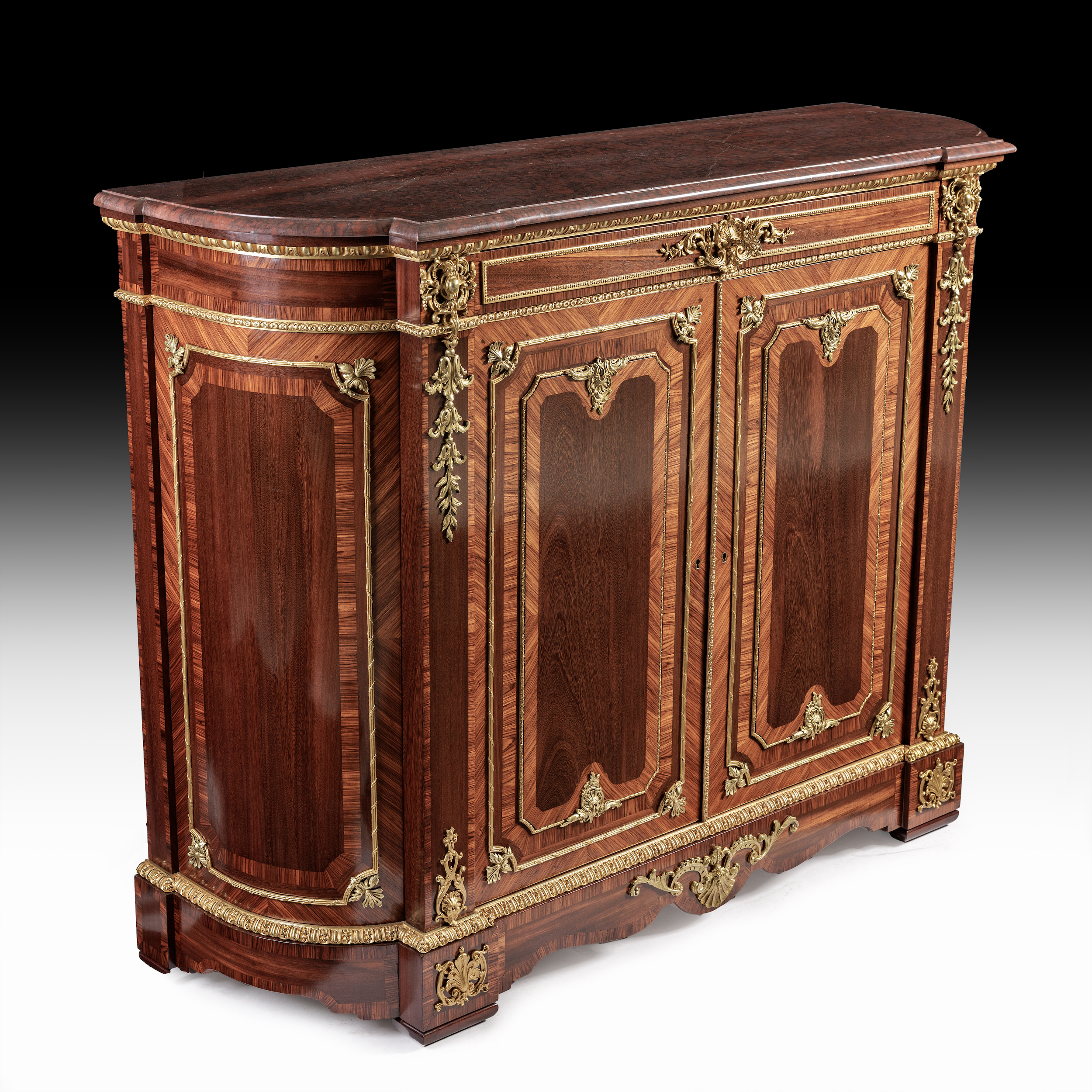
Yes, a word too readily used…everywhere. As such, we thought we’d let this cabinet speak for itself. Enquire about this cabinet.
Exceptional.
Yes, a word too readily used…everywhere.
However, when a piece really is, it has to be said when that piece truly fits the bill.
The finest materials. Intricate details. Superb craftsmanship.
This 19th Century French Side Cabinet with a purple heart and tulip wood frieze, pierced ormolu mounts, and cross-banded doors has all these in abundance.
Throughout the 19th century, French cabinetmaking reached a remarkable fusion of technical mastery, historical revivalism, and creative innovation. Side cabinets—also known as buffets, or credenzas, depending on their form—became essential furnishings in the most fashionable interiors of the time. They served not only practical storage purposes but also acted as prominent showcases for the decorative arts. The period’s leading ébénistes drew inspiration from 18th-century Rococo and Neoclassical traditions, yet adapted them to the tastes of a society undergoing rapid industrial and cultural transformation.
A quintessential example of this craftsmanship can be seen in this exceptional 19th-century French four-door side cabinet: a piece distinguished by its shaped marble top, purple-heart and tulipwood frieze, and finely pierced gilded bronze mounts. Such cabinets often balanced elegance with structural ingenuity. Marble, frequently sourced from quarries in the south of France or Italy, provided both a luxurious visual anchor and a durable working surface. Its shaped edges were not merely decorative; they softened the cabinet’s silhouette and elevated it above the simplified forms of earlier centuries.
The body of the cabinet reveals the sophisticated woodcraft associated with the great Parisian workshops. Purple-heart, a dense and naturally vibrant timber imported from South America, was prized during this period for its exotic appearance and ability to hold a crisp polish. Tulipwood, favoured since the days of Louis XV for its warm striations, provided an elegant contrast. These veneers were carefully laid over a carcass.
Cross-banding, as seen on the cabinet’s panelled doors, demonstrated both restraint and refinement. It required meticulous cutting and matching of veneer strips to frame a central panel, producing a decorative border that highlighted the geometry of the doors. The curved panelled ends further reveal the technical ambition of the craftsman. Creating such curvature required bending and shaping the substrate before applying the veneer—an operation demanding both precision and patience.
Perhaps the most telling markers of quality, however, lie in the mounts. Finely pierced and gilded bronze mounts, or ormolu, was a long-standing hallmark of elite French furniture. In the 19th century, these mounts were shaped and chiselled by specialised bronziers who worked closely with cabinetmakers. Their role was both protective—shielding vulnerable edges—and decorative, enhancing the interplay of materials through glinting, sculptural detail.
Raised on square feet and enclosing capacious cupboards, this cabinet represents the union of beauty and function that defined 19th-century French design. While rooted in classical taste, its craftsmanship reflects a period of renewed appreciation for artisanal skill in an age increasingly shaped by mechanisation. Enquire about this cabinet.
Such pieces are enduring expressions of the artistry and cultural values of their time.
Please click here to discover more.